🔗 As an Amazon Associate, I earn from qualifying purchases at no extra cost to you.
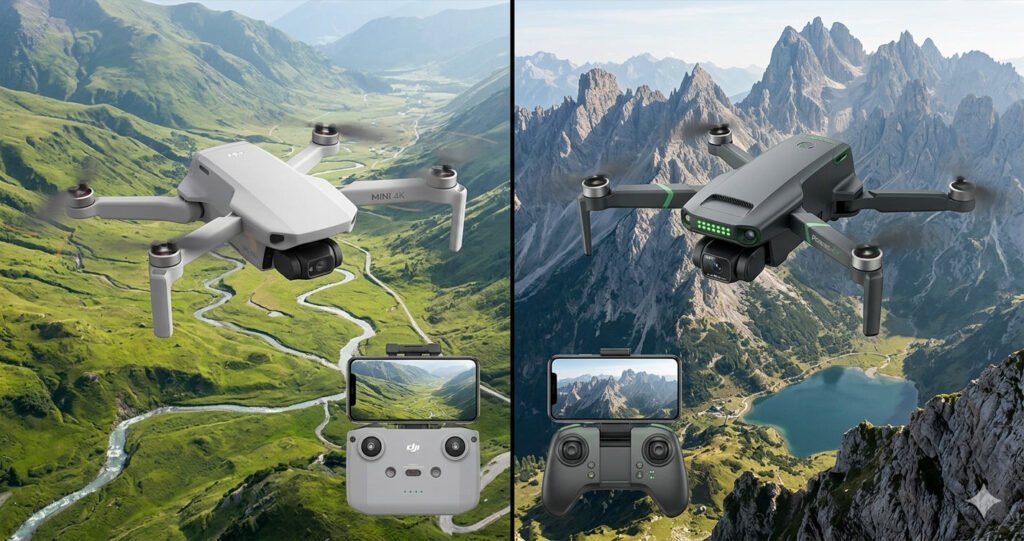
These two drones come up in the same conversation constantly — and the question has gotten more interesting in 2026 as prices have shifted. The DJI Mini 4K has dropped significantly from its original launch price and now sits around $209 for the base bundle. The Potensic ATOM SE has settled at $249.99 for the standard kit. That means the Mini 4K is actually cheaper than the ATOM SE right now — which changes the math on this comparison considerably.
Both are under 250g, both have GPS, brushless motors, and 4K cameras, and they’re both genuinely good drones at their price points. But they’re not the same drone and they’re not right for the same person. Here’s the honest breakdown.
Side-by-Side Specs
| Feature | DJI Mini 4K | Potensic ATOM SE |
|---|---|---|
| Price (base) | ~$209 on Amazon | ~$249.99 on Amazon |
| Price (Fly More) | ~$309 | ~$299.99 |
| Weight | 246g | 249g |
| FAA Registration | Not required | Not required |
| Flight Time | 31 min/battery (~25–28 real) | 31 min/battery (~25–28 real) |
| Camera | 4K UHD | 4K Sony CMOS |
| Stabilization | 3-axis mechanical gimbal | Electronic (EIS) |
| Motors | Brushless | Brushless |
| Video Transmission | 10km DJI O2 | 4km Pixsync 2.0 |
| Smart Modes | QuickShots, Panorama, Hyperlapse | Follow Me, Orbit, Waypoints |
| Wind Resistance | Level 5 (38 km/h) | Level 5 (38 km/h) |
| Obstacle avoidance | None | None |
| App | DJI Fly (best in class) | Potensic Go |
| Accident protection | DJI Care Refresh (~$29/yr) | None |
Camera & Stabilization: The Biggest Real-World Difference
This remains the most important difference between the two, and it hasn’t changed with price.
The DJI Mini 4K has a 3-axis mechanical gimbal — three small motors physically stabilize the camera, compensating for the drone’s movement in real time. The result is footage that looks smooth in almost all conditions. When you watch footage from the Mini 4K, the camera appears to float independently of the drone itself.
The ATOM SE uses Electronic Image Stabilization (EIS) — the camera is fixed to the frame and software compensates for shake. The Sony CMOS sensor produces genuinely good color accuracy, and EIS footage is usable in calm conditions. But in moderate wind, EIS shows its limits: micro-jitter in panning shots, vibration during fast direction changes.
In calm conditions the gap is smaller than you’d expect. In wind it’s obvious.
The gimbal advantage used to cost you $70 extra. Now it doesn’t. Read the full ATOM SE camera breakdown →
Better footage in any wind, now at a lower price. DJI Mini 4K on Amazon →
Flight Time & Battery Value
Per battery, these drones are evenly matched — both deliver around 25–28 minutes of real-world flight on a 31-minute rated pack.
The Fly More combo story is now essentially a draw on price: DJI’s combo runs ~$309, Potensic’s runs ~$299.99. Both include three batteries and a charging hub. The ATOM SE combo typically includes a travel bag; DJI’s doesn’t always — check the specific listing. Previously the ATOM SE Fly More was dramatically cheaper. That advantage has largely evened out.
Combo pricing is now nearly identical (~$10 apart). The ATOM SE retains a marginal edge with the travel bag. ATOM SE Fly More → DJI Mini 4K Fly More →
Video Transmission & Range
The DJI Mini 4K uses DJI O2 transmission, rated to 10km. The ATOM SE uses Pixsync 2.0, rated to 4km with 720p live view.
In real-world recreational flying within visual line of sight, both transmit a stable feed. The DJI advantage shows up in RF-heavy environments — urban areas, crowded parks, near radio towers — where the O2 signal holds more reliably under 2.4GHz interference. For most recreational use, neither ceiling is a practical constraint.
Technically superior at 10km, and more resilient in crowded signal environments. The practical difference is small for most flying — but it’s real.
App & Smart Features
DJI Fly remains the best consumer drone app available — clean interface, reliable QuickShots (Dronie, Helix, Rocket, Boomerang, Circle, Asteroid), Panorama modes, Hyperlapse, and LAANC airspace integration built in. DJI’s firmware update track record is also strong.
The Potensic Go app has improved significantly and is genuinely reliable. But more importantly: it includes features the Mini 4K simply doesn’t have. Waypoints lets you pre-program a flight path on a map and fly it automatically. Follow Me has the drone track and follow a subject using GPS. These are locked to higher-tier DJI models — the Mini 4K doesn’t get them at any price.
If you want to fly a pre-planned route over a hiking trail or have the drone follow you on a bike ride, the ATOM SE can do it and the Mini 4K can’t. Full stop.
DJI Fly is more polished. Potensic Go has Waypoints and Follow Me that the Mini 4K lacks entirely. The right app is the one with the features you’ll actually use.
Build Quality, Support & Reliability
DJI’s engineering is industry-leading at this price. The Mini 4K feels solid, the folding mechanism is precise, and DJI’s firmware update record and long-term part support are both excellent. If you plan to use this drone for 2–3 years, DJI’s track record matters.
The ATOM SE is well-built for the price — the ATOM line represents a step up in quality control from earlier Potensic models, and community feedback on reliability has been positive. It’s not DJI-level fit and finish, but it’s solid.
DJI also offers DJI Care Refresh (~$29/year) — accident protection covering flyaways, water damage, and crashes with a replacement unit. For new pilots still building spatial awareness, Care Refresh is genuinely worth it. There’s no equivalent for the ATOM SE.
Better build quality, stronger long-term firmware support, and DJI Care Refresh is a real advantage for new flyers.
Which One Should You Buy?
Buy the DJI Mini 4K if…
- You want the best image quality — now at the lowest price
- You fly in wind regularly (gimbal handles it; EIS doesn’t)
- You want QuickShots, the best app, the most polished experience
- You want DJI Care Refresh crash protection
- Long-term reliability and resale value matter
- You’re a beginner — DJI Fly is more intuitive and Care Refresh covers mistakes
Buy the Potensic ATOM SE if…
- You need Waypoints or Follow Me — the Mini 4K has neither
- You fly mostly in calm conditions and want the Sony color science
- You’re buying the Fly More combo (~$10 less, typically includes a bag)
- You already prefer the Potensic ecosystem
Not sure either fits your budget? See our best drones under $300 and best drones under $500 guides for the full field.
Frequently Asked Questions
Is the Potensic ATOM SE worth it over the DJI Mini 4K in 2026?
For most buyers, no. The Mini 4K is now less expensive (~$209 vs ~$249.99) and has a better camera thanks to the mechanical gimbal. The ATOM SE still makes sense if you specifically need Waypoints or Follow Me mode — features the Mini 4K doesn’t offer at any price. Outside of that use case, the Mini 4K is the stronger buy.
Does either drone need FAA registration?
Neither requires registration. The DJI Mini 4K is 246g and the ATOM SE is 249g — both under the FAA’s 250g threshold for recreational use. You still need to follow FAA operating rules (fly below 400 feet, avoid restricted airspace, maintain visual line of sight), but no registration paperwork required.
Which is better for beginners?
Both are approachable. DJI Fly is slightly more intuitive out of the box, and DJI Care Refresh is genuine peace of mind when you’re still developing spatial awareness. At current pricing, the Mini 4K is the stronger beginner pick. Check our first-flight guide before you head out either way.
How do they compare on wind resistance?
Both are rated Level 5 (38 km/h). The drone frames handle wind similarly — the difference shows up in footage. The Mini 4K’s gimbal keeps the camera steady; the ATOM SE’s EIS starts showing jitter in the same conditions. Same wind resistance rating, noticeably different results on screen.
Is the DJI Mini 4K discontinued?
No — as of mid-2026 it’s an active product. The price drop appears to be permanent positioning rather than a clearance event, though DJI product cycles can shift. Always verify current pricing before purchasing.
The Verdict
The DJI Mini 4K is now both the better drone and the cheaper drone. Mechanical gimbal, 10km transmission, best-in-class app, Care Refresh, and stronger long-term support — all for ~$209. For most buyers, the decision isn’t close anymore.
The Potensic ATOM SE still earns a recommendation — but for a specific buyer. If Waypoints or Follow Me are on your list, this is the only drone at this price that delivers them. That’s a real, meaningful capability advantage. Just make sure those features are actually part of your use case before you pay a $40 premium over the Mini 4K to get them.
Either way, you’re buying a good drone. The gap between them has just narrowed in DJI’s favor.
DJI Mini 4K → Potensic ATOM SE →Keep Reading
Last updated: June 2026. Prices verified June 2026 — DJI Mini 4K base ~$209, ATOM SE base ~$249.99, both Fly More combos ~$299–309. Always verify current pricing before purchasing.