🔗 As an Amazon Associate, I earn from qualifying purchases at no extra cost to you.
If you’re new to drones and trying to figure out what to buy, you’ve probably run into two very different kinds of drone content online — videos of smooth, cinematic aerial shots over landscapes, and videos of something that looks like a fighter jet flying through trees at 80mph. Same hobby, totally different experience.
The question of whether to go FPV or camera drone trips up a lot of beginners because the two categories have almost nothing in common except that they fly. The skills are different, the gear is different, the experience is different, and what you get out of it is different. Picking the wrong one isn’t the end of the world, but it’s an easy mistake to avoid if you know what you’re actually choosing between.
This guide will walk you through both clearly — FPV vs camera drones, what each one actually is, who it’s for, and how to figure out which direction fits what you’re looking for.
- You see what the drone sees through goggles
- Manual control — no GPS autopilot in real flying
- Flying fast, low, through things is the point
- Steeper learning curve, more crashes early on
- The experience of flight is the reward
- Entry kit: ~$170–310 complete
- GPS holds position; drone flies itself steadily
- Gimbal-stabilized camera — smooth footage from day one
- Aerial photography and videography is the point
- Shallow learning curve, forgiving for new pilots
- The footage you get is the reward
- Entry kit: ~$209–299 complete
What Is a Camera Drone?
A camera drone — sometimes called a GPS drone or a photography drone — is what most people picture when they think “drone.” It flies itself. You tell it where to go with the sticks, it uses GPS to hold position, and it comes back home if it loses signal or the battery gets low. The camera is on a stabilized gimbal, so the footage looks smooth regardless of wind or minor stick input. Most of them are foldable and light enough to carry in a backpack.
The DJI Mini 4K is a good example of what the modern camera drone looks like at entry level — it’s 246g, fits in a jacket pocket, has a 3-axis gimbal, shoots genuine 4K video, and is designed so that someone with zero experience can have stable, good-looking footage within a few minutes of unboxing it.
The appeal is accessibility. You don’t need to practice for months before getting usable results. Point it at a mountain, a lake, a city skyline, or your friend’s backyard wedding, and you’ll come back with footage that looks like it cost money. That’s genuinely remarkable, and it’s why GPS camera drones are what most people start with.
They’re also safer in the hands of a new pilot. GPS hold means the drone stays where you put it. Return to Home means it lands itself if something goes wrong. Obstacle sensing (on higher-end models) means fewer crashes into things you didn’t see coming. The technology is doing a lot of the work, which is the point.
📷 You Should Get a Camera Drone If…
- You want great aerial footage, without a long learning investment
- Photography or videography is the main goal — travel, real estate, events, landscapes
- You’re not interested in the hardware/technical side of the hobby
- Flying mostly outdoors in open spaces
- Crashing a lot while learning doesn’t sound fun
Best starting point: The DJI Mini 4K at ~$209 — under 250g, 3-axis gimbal, 4K, no FAA registration needed. If you want more total flight time, the Potensic ATOM SE Fly More combo at ~$299 includes three batteries and a charging hub.
DJI Mini 4K on Amazon → Potensic ATOM SE on Amazon →What Is an FPV Drone?
FPV stands for First Person View. You wear goggles, the drone’s camera feeds a live video stream to those goggles, and you see what the drone sees — in real time. You are, for all practical purposes, inside the drone.
It’s a completely different experience from flying a camera drone. There’s no GPS holding your position. The drone doesn’t stabilize itself when you let go of the sticks (in proper manual mode). You are the autopilot. And the flying itself — not the footage — is the point.
FPV pilots fly through gaps in trees. They race gates. They do flips and rolls. They fly centimeters from the ground at speeds that make the video look like a low-budget action movie. Some of them do fly FPV to capture cinematic footage — that’s the “cinewhoop” style — but even then, the draw is the pilot’s skill and creativity, not just pointing a stabilized camera at something beautiful.
The learning curve is real. You’ll crash. A lot, at first. You’ll replace props. You’ll occasionally break something. But the community is welcoming, the hardware is cheap enough that crashes aren’t expensive disasters, and the progression from “barely keeping it in the air” to “flying through a doorway smoothly” is one of the more satisfying skill arcs in any hobby.
What FPV gives you that camera drones can’t: the physical experience of flight. The footage from an FPV drone is immersive because the camera was actually there, moving at speed, threading through the environment. You can’t fake that with a gimbal.
🚀 Who Should Get a FPV Drone
You’re the FPV drone person if most of these are true:
- The experience of flying is what draws you — not just having aerial footage
- You want to develop a real skill and you’re okay with a learning curve
- Dynamic, immersive video is more interesting than smooth cinematic shots
- You’d enjoy a hobby with a community, upgrade paths, and genuine progression
- You’re comfortable with occasional crashes and minor repairs
Best starting point: The BetaFPV Cetus X Kit at ~$310 — drone, goggles with DVR, LiteRadio 3 controller, and three flight modes that grow with your skill level. Before you buy anything, spend $20 on Liftoff on Steam and practice for a week — it’ll confirm FPV is for you before you spend more. Budget tighter? The BetaFPV Cetus Pro Kit at ~$170–200 is a good trial investment.
BetaFPV Cetus X on Amazon → BetaFPV Cetus Pro on Amazon →The Third Option: The DJI Avata 2
Before getting into the decision framework, the DJI Avata 2 is worth acknowledging because it sits deliberately between the two worlds. It’s a cinewhoop — an FPV-style drone with built-in prop guards and a stabilized 4K camera. The motion controller lets you fly it one-handed with natural gestures. The footage looks cinematic. You don’t need months of practice to get usable results.
It’s essentially asking: what if you wanted the FPV feel without the FPV learning curve?
The answer is that it works, with trade-offs. The motion controller isn’t a real radio — if you want to develop actual FPV pilot skills, the Avata 2 won’t teach you much. And at $409 for the drone alone (you still need goggles), it’s the most expensive entry point on this list. But for a content creator who wants the immersive, dynamic look of FPV footage without going deep into the hobby, it’s a legitimate option worth knowing about.
🎬 Consider the DJI Avata 2 If…
- You want the immersive, dynamic look of FPV footage specifically
- You’re a content creator and footage quality matters as much as the experience
- You don’t want to invest months in learning manual FPV skills
- You already fly camera drones and want a different visual style
- Budget isn’t the primary constraint
The DJI Avata 2 starts at $409 drone-only — the Fly More combo with goggles runs $849. It’s not a budget purchase, but the one-handed motion controller and stabilized 4K footage at 155° FOV are genuinely impressive right out of the box.
DJI Avata 2 on Amazon →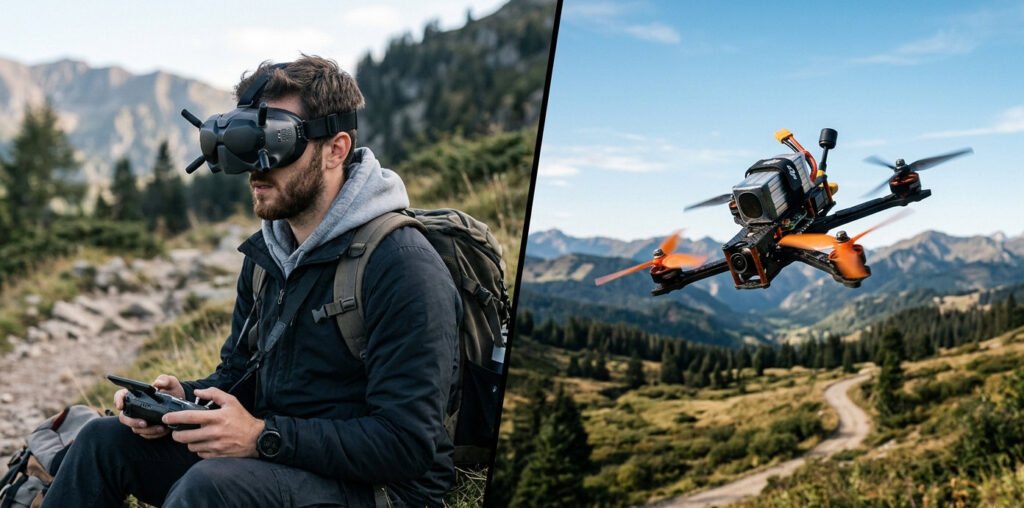
Six Questions to Figure Out Which One Is Right for You
Aerial shots of landscapes, travel, events, real estate -> camera drone. Fast, immersive – FPV or Avata 2. Don’t care about footage, just want to fly fast – FPV.
Camera drones can be flown well within an hour of unboxing. FPV takes weeks to get comfortable, months to get good. If you want results quickly, camera drone. If the skill development is part of the appeal, FPV.
Open outdoor spaces with room to breathe -> both work. Indoor spaces, tight areas, close-in flying -> FPV whoops are built for this. Camera drones need GPS signal and airspace to be genuinely useful.
Camera drones crash occasionally. FPV drones crash regularly while learning — it’s normal, repairs are minor, but it happens. If crashing your gear bothers you more than challenges you, start with a camera drone.
FPV has a deep hobby ecosystem — Betaflight tuning, custom builds, racing leagues, freestyle communities. Camera drone ownership tends to be more about the output. If the tinkering and progression sound exciting, FPV will hold your interest for years.
Both categories have comparable entry costs. A solid camera drone setup (DJI Mini 4K + extra battery) runs about $250. A complete FPV starter kit (BetaFPV Cetus X) runs $310. Add $20 for a simulator if you go FPV. Where FPV gets more expensive over time is upgrades — better goggles, bigger quads. Camera drone costs tend to plateau after the initial purchase.
The Quick Answer
Get a camera drone if you want great aerial footage with minimal learning investment.
Get an FPV drone if you want to actually learn to fly and the experience of flying is the point.
Get the DJI Avata 2 if you want FPV-style footage without learning FPV properly, and budget isn’t the constraint.
Most people who aren’t sure start with a camera drone — it delivers results fast, it’s forgiving to learn on, and you can always add FPV later. Plenty of people fly both.
Best Camera Drones → Best FPV Kits →